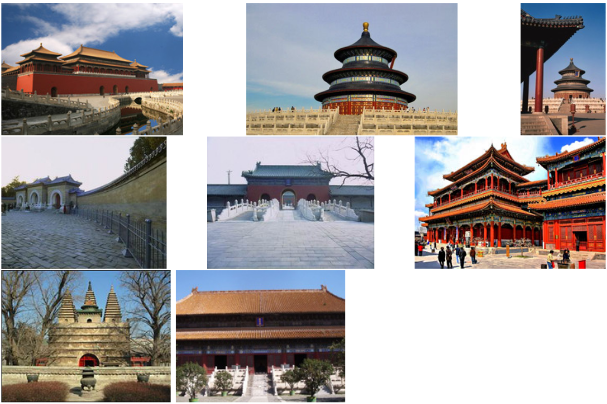
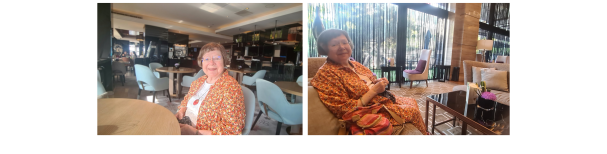
Next: Oslo: 2 June Up: Kari & Dines: Travels Previous: Contents Contents
Some Tokyo Restaurant Reservations.
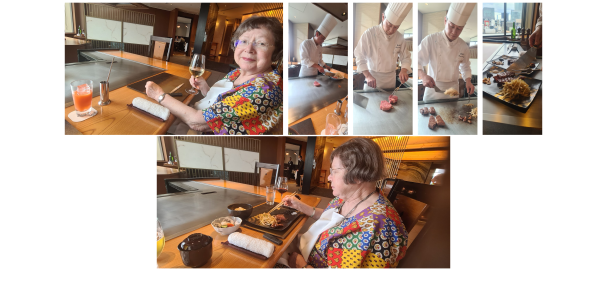
Teppanyaki (鉄板焼き, teppan-yaki), often confused with hibachi (火鉢, "fire bowl"), is a post-World War II style of Japanese cuisine that uses an iron griddle to cook food. The word teppanyaki is derived from teppan (鉄板), the metal plate on which it is cooked, and yaki (焼き), which means grilled, broiled, or pan-fried. In Japan, teppanyaki refers to dishes cooked using a teppan, including steak, shrimp, okonomiyaki, yakisoba and monjayaki.
Teppan are typically propane-heated, flat-surfaced, and are widely used to cook food in front of guests at restaurants. They are commonly confused with the hibachi barbecue grill, which is called shichirin in Japanese, and has a charcoal or gas flame and is made with an open grate design. With a solid griddle-type cook surface, the teppan is capable of cooking small or semisolid ingredients such as rice, egg and finely chopped vegetables.
Kaiseki: (懐石) or kaiseki-ryōri (懐石料理) is a traditional multi-course Japanese dinner. The term also refers to the collection of skills and techniques that allow the preparation of such meals and is analogous to Western haute cuisine.
There are two kinds of traditional Japanese meal styles called kaiseki or kaiseki-ryōri. The first, where kaiseki is written as "会席" and kaiseki-ryōri as "会席料理", refers to a set menu of select food served on an individual tray (to each member of a gathering). The second, written as "懐石" and as "懐石料理", refers to the simple meal that the host of a chanoyu gathering serves to the guests before a ceremonial tea, and is also known as cha-kaiseki . The development of nouvelle cuisine was likely inspired by kaiseki principles.
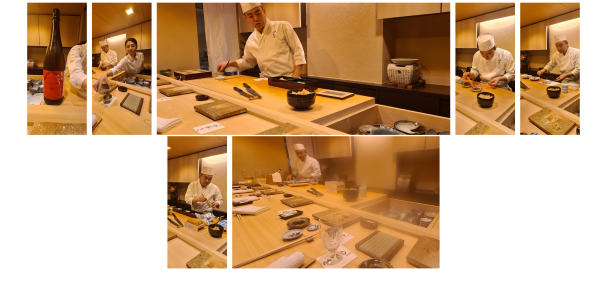
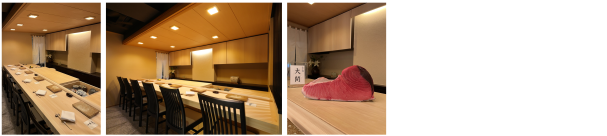
Sushi: (すし, 寿司, 鮨, 鮓, pronounced [sɯɕiꜜ] or [sɯꜜɕi] ⓘ) is a Japanese dish of prepared vinegared rice (鮨飯, sushi-meshi), usually with some sugar and salt, plus a variety of ingredients (ねた, neta), such as vegetables, and any meat, but most commonly seafood (often raw but can be cooked). Styles of sushi and its presentation vary widely, but the one key ingredient is "sushi rice", also referred to as shari (しゃり), or sumeshi (酢飯).
The creator of modern sushi is believed to be Hanaya Yohei, who invented nigiri-zushi, a type of sushi most known today, in which seafood is placed on hand-pressed vinegared rice, around 1824 in the Edo period (1603–1867). It was the fast food of the chōnin class in the Edo period.
Sushi is traditionally made with medium-grain white rice, though it can be prepared with brown rice or short-grain rice. It is very often prepared with seafood, such as squid, eel, yellowtail, salmon, tuna or imitation crab meat. Many types of sushi are vegetarian. It is often served with pickled ginger (gari), wasabi, and soy sauce. Daikon radish or pickled daikon (takuan) are popular garnishes for the dish.
Sushi is sometimes confused with sashimi, a dish that consists of thinly sliced raw fish or occasionally meat, without sushi rice.
Condé Nast: Best Places for Sushi in Tokyo
The fugu (河豚; 鰒; フグ) in Japanese, bogeo (복어; -魚) or bok (복) in Korean, and hétún (河豚; 河魨) in Standard Modern Chinese is a pufferfish, normally of the genus Takifugu, Lagocephalus, or Sphoeroides, or a porcupinefish of the genus Diodon, or a dish prepared from these fish.
Fugu possesses a potentially fatal poison known as tetrodotoxin, therefore necessitating meticulous preparation to eliminate poisonous components and prevent the fish meat from being contaminated.
The restaurant preparation of fugu is strictly controlled by law in Japan, Korea and several other countries, and only chefs who have qualified after three or more years of rigorous training are allowed to prepare the fish. Domestic preparation occasionally leads to accidental death.
Throughout Japan, fugu is served as sashimi and nabemono. The liver was served as a traditional dish named fugu-kimo, being widely thought to be a tasty part, but it is also the most poisonous, and serving this organ in restaurants was banned in Japan in 1984. In the gastronomic domains of East Asian cuisine, fugu has emerged as a highly renowned delicacy, garnering widespread acclaim in establishing itself as one of the most celebrated dishes in Japanese and Korean cuisine. Fugu has also been gradually emerging as a prized seafood delicacy in the Chinese culinary landscape as well.
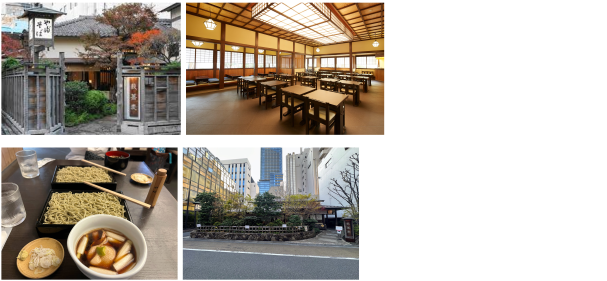
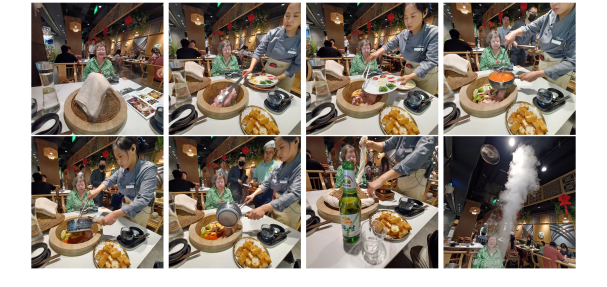
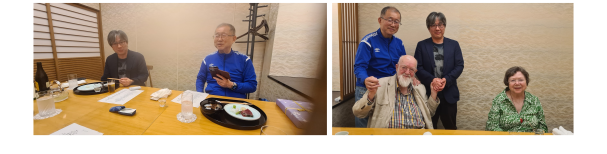
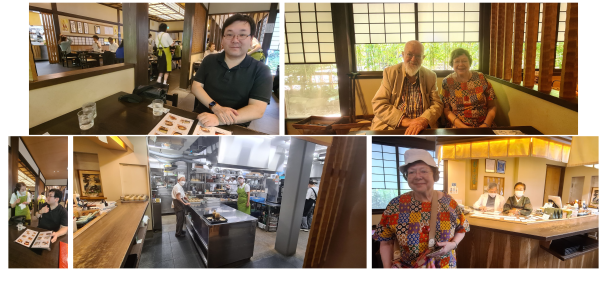
Yabu Soba opened its doors for business in 1880. “Soba”, or buckwheat noodles, tempura and sushi, are three popular Japanese dishes that date back to the Edo Period. Soba noodles are a favorite anytime all over Japan, but are also traditionally enjoyed on certain special occasions such as New Years or when someone moves, and are said to bring good fortune.
Our soba noodles are served “seiro”, style–that is, firm noodles made from ten parts buckwheat flour to one part wheat flour, which are then dipped in a tasty broth and enjoyed. We also offer Tendane–soba noodles in tsuyu soup with crispy deep-fried shrimp on the side–and Tempura soba–noodles in broth with deep-fried shrimp on top.
Soba: (そば or 蕎麦, "buckwheat") are Japanese noodles made primarily from buckwheat flour, with a small amount of wheat flour mixed in.[1] It has an ashen brown color, and a slightly grainy texture. The noodles are served either chilled with a dipping sauce, or hot in a noodle soup. They are used in a wide variety of dishes.
In Japan, soba noodles can be found at fast food venues to expensive specialty restaurants.[2] Dried soba noodles are sold in stores, along with men-tsuyu, or instant noodle broth, to make home preparation easy.[3]
The amino acid balance of the protein in buckwheat, and therefore in soba, is well matched to the needs of humans and can complement the amino acid deficiencies of other staples such as rice and wheat (see protein combining). The tradition of eating soba arose in the Edo period.
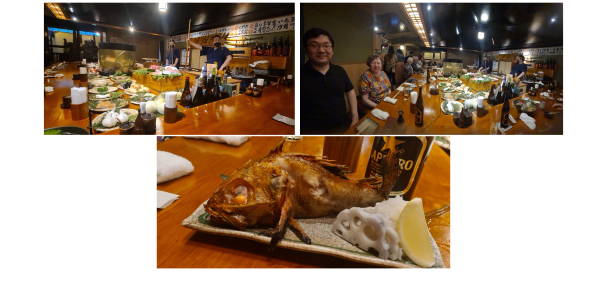
In Japanese cuisine, robatayaki (炉端焼き, literally "fireside-cooking"), often shortened to robata (ろばた in hiragana), refers to a method of cooking, similar to barbecue, in which items of food are cooked at varying speeds over hot charcoal. Many Japanese restaurants, both in Japan and abroad, specialize in this style of food preparation. Traditionally, the food consists of a combination of morsels of seafood and vegetables, but other kinds of food that are suitable for grilling may also be offered. The robata cooking style is different from other Japanese charcoal cooking in that it uses a wide, flat open fireplace in the style of an irori, rather than a shichirin or other type of charcoal cooking implement.
Ramen: (/ˈrɑːmən/) (拉麺, ラーメン or らーめん, rāmen, [ɾaꜜːmeɴ] ⓘ) is a Japanese noodle dish of Chinese origin. It consists of Chinese-style wheat noodles (中華麺, chūkamen) served in a broth; common flavors are soy sauce and miso, with typical toppings including sliced pork (chāshū), nori (dried seaweed), menma (bamboo shoots), and scallions. Ramen has its roots in Chinese noodle dishes and is a part of Japanese Chinese cuisine.[1] Nearly every region in Japan has its own variation of ramen, such as the tonkotsu (pork bone broth) ramen of Kyushu and the miso ramen of Hokkaido.
The origins of ramen can be traced back to Yokohama Chinatown in the early 20th century. The word "ramen" is a Japanese borrowing of the Chinese word lamian (拉麵), meaning "pulled noodles", but the dish evolved from southern Chinese noodle dishes, reflecting the demographics of Chinese settlers in Yokohama. Ramen gained popularity in Japan, especially during food shortages following World War II. In 1958, instant noodles were invented by Momofuku Ando, further popularizing the dish.
Today, ramen is a cultural icon in Japan, with many regional varieties and a wide range of toppings. Examples include Sapporo's rich miso ramen, Hakodate's salt-flavored ramen, Kitakata's thick, flat noodles in pork-and-niboshi broth, Tokyo-style ramen with soy-flavored chicken broth, Yokohama's Iekei Ramen with soy flavored pork broth, Wakayama's soy sauce and pork bone broth, and Hakata's milky tonkotsu (pork bone) broth. Ramen is offered in various establishments and locations, with the best quality usually found in specialist ramen shops called ramenya (ラーメン屋).
Ramen versus Soba Noodles:
The main difference between the two types of noodles is their flavor. Soba noodles are typically made with buckwheat flour, but ramen noodles are made from a more traditional wheat flour. This means that ramen noodles will be unsuitable for anyone with a wheat intolerance or who wishes to avoid gluten.
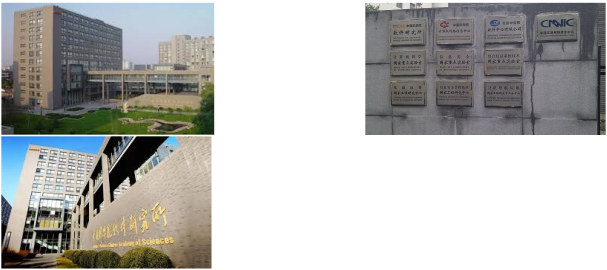
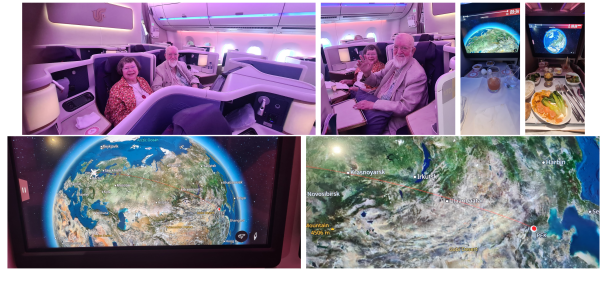
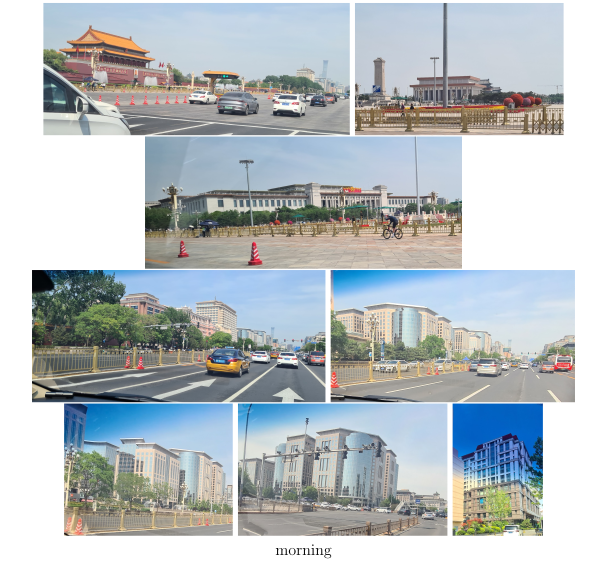
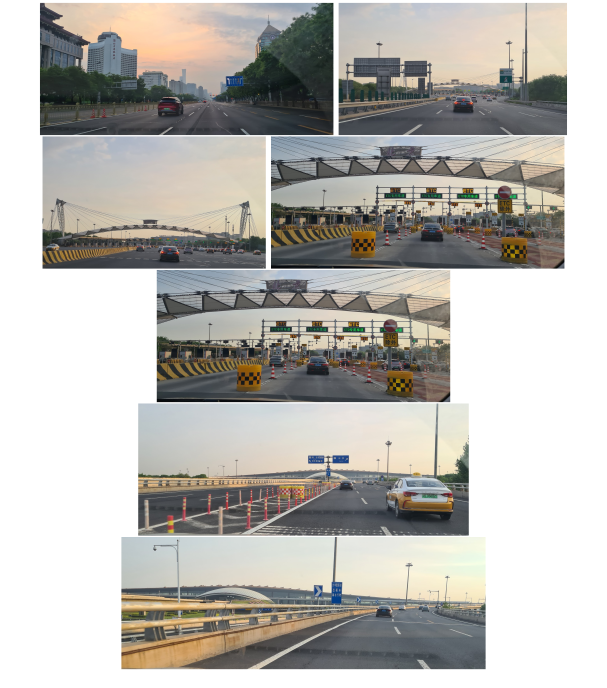
Main purpose of visit to Beijing is to work, 2 weeks, at
ISCAS:
Institute of Software, Chinese Academy of
Sciences
based on
based on
based on
 |
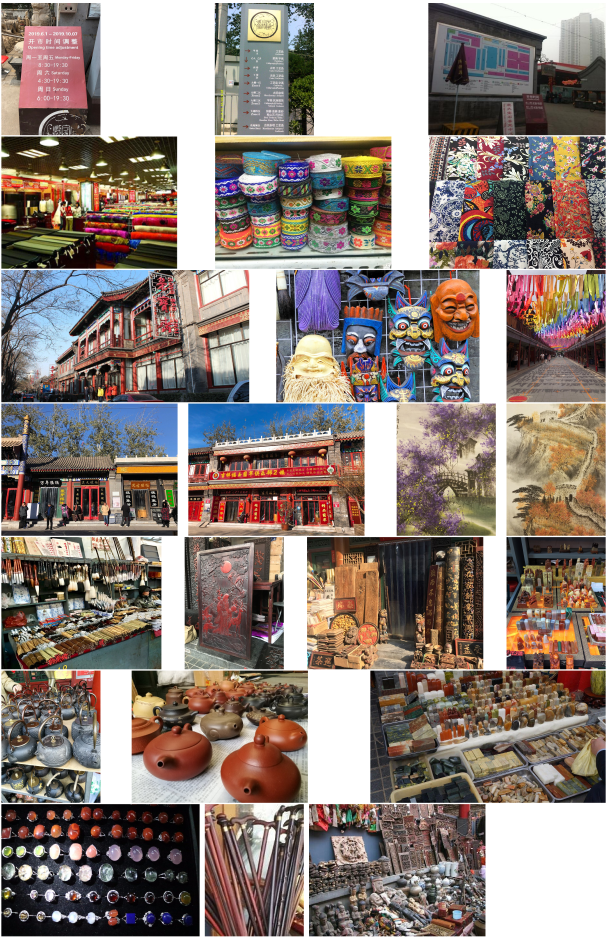
At the east of Beijing, the Gao Bei Dian village is now among the main city’s areas to find furniture: antique furniture (genuine or not, you’d better be careful), decoration items, lamps, carpets, beds, tables…!
As the whole, the place is a kind of high-standard second-hand market dispatched in several stores located in the same street, each one of those stores having its own style and selling different kinds of furniture.
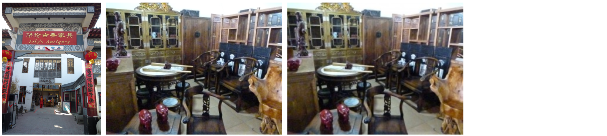
Jinzhan Antique Furniture Market
If you are into antique Chinese furniture, then the Jinzhan Antique Furniture Market in the northeast suburb of Beijing should be your go-to. The market is in a large warehouse, and due to its far-off location there are not as many visitors, which is good for those who are tired of fending off the crowds.
West Entrance of Xiaodian Village, Jinzhan Township (Opposite to the Yujinxiang Huayuan), Chaoyang District, Beijing, +8610 64368595 Gaobeidian Classical Furniture Street
Gaobeidian Classical Furniture Street is the Holy Grail of all antique furniture stores. The antique furniture sold here has all undergone renovation and is amazing quality. There’s a particularly fancy showroom on the second floor where you can find plenty of stylish furniture from Old Shanghai.
Gaobeidian Village, Chaoyang District, Beijing
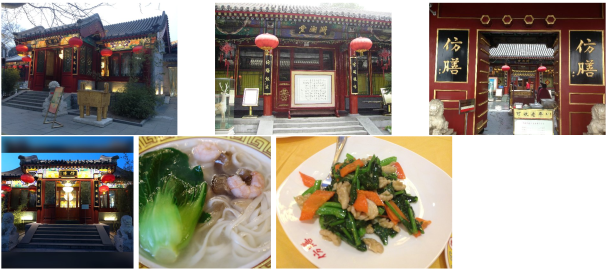
Fangshan Restaurant 仿膳饭庄 Restaurant , Beihai Park
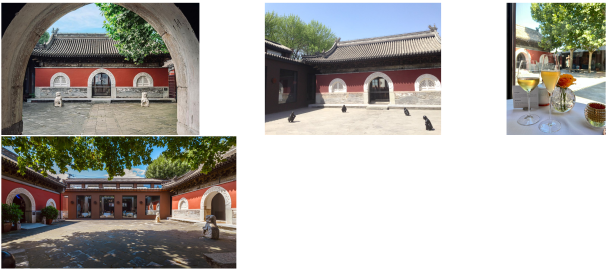
TRB
Hutong
No. 23, Shatanbeijie,
Dongcheng District
Beijing’s 100+ Year Old Restaurants
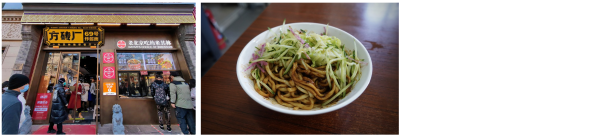
Fangzhuanchang
Hutong
Fangzhuanchang Zhajiangmian, 1 Fangzhuangchang hutong, Dongcheng
District, Beijing, tel: 136911 50449. Open: 10.30am-7pm,
No. 69 Fangzhuanchang Zhajiangmian and
Check out Fangshan Restaurant
(Beihai) on
Tripadvisor
 |
 |
 |
 |
 |
 |
 |

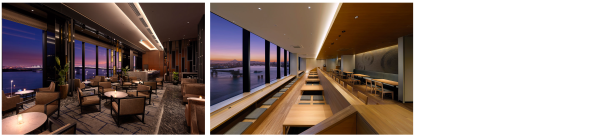
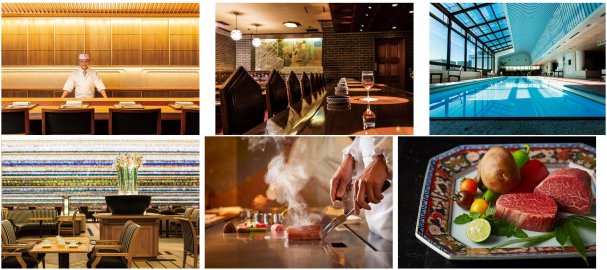
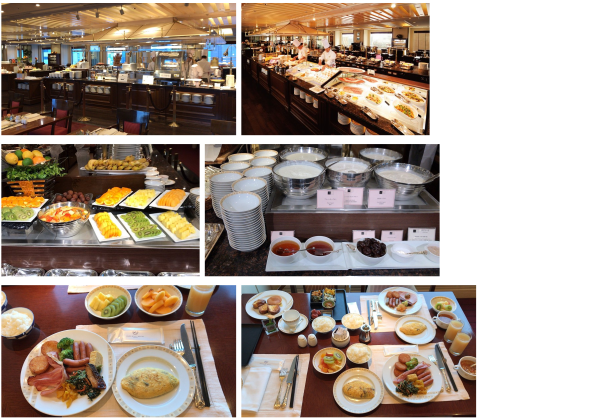
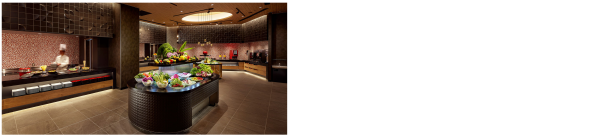
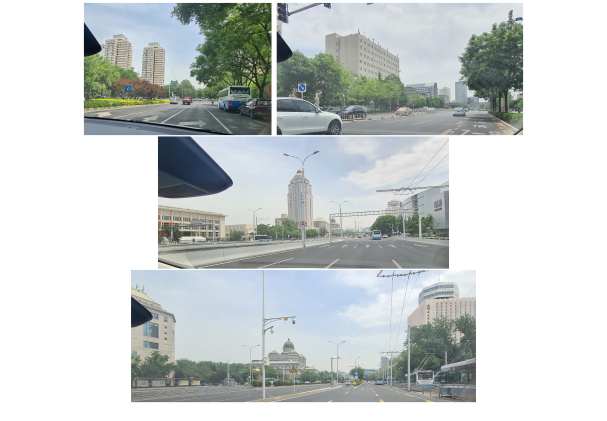
![\begin{figure}%%% \begin{center}
\epsfig{file=imp5.jpg,height=35mm}\
\epsfig{f...
...35mm}\\ [2mm]
\epsfig{file=imp6.jpg,height=35mm}
%% \end{center}\end{figure}](img9.svg)
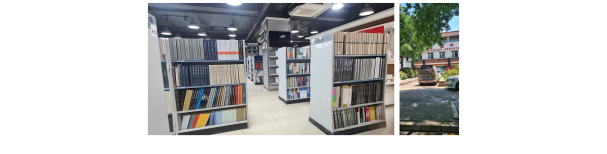
![\begin{figure}%%% \begin{center}
\epsfig{file=ms0.jpg,height=35mm}\
\epsfig{fi...
...=35mm}\\ [2mm]
\epsfig{file=ms5.jpg,height=35mm}
%% \end{center}\end{figure}](img12.svg)
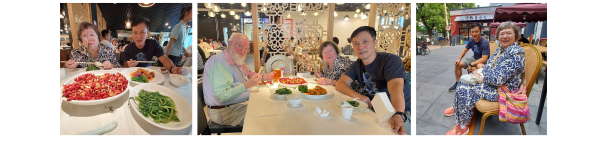
![\begin{figure}%%% \begin{center}
\epsfig{file=soba4.jpg,height=35mm}\
\epsfig{...
...5mm}\\ [2mm]
\epsfig{file=soba1.jpg,height=35mm}
%% \end{center}\end{figure}](img13.svg)